AI PRODUCT · WEB · IOS · WEB APP · 2025—NOW
Darma
Designing when AI should act — and when humans should step in.
Darma is an AI assistant that negotiates scheduling on a user's behalf — inside real email threads — and knows when to stop and bring the human back in.
- Role
- Product Designer → Product Lead
- Team
- 6 engineers, 5 countries
- Status
- Early access
- Platform
- iOS · Web · Email
An email arrives. Darma reads it.
From AI chat to AI coordination
Chat-first · iOS only → Email-native · iOS + Web
Darma started as a dark, chat-first iOS app built around one interaction: you asked, it answered. As the product moved into B2B2C, the interface got lighter — and the core interaction moved out of the app entirely.
“The interaction moved from talking to Darma — to letting it handle the conversation.”
The interface was no longer the conversation
The real interaction moved into email. Darma could be copied into a thread — read the context, negotiate times, handle rejections, and reach an agreement on its own.
Email gave almost no visual space to design in. So the work was heavily UX-driven: what should Darma propose? How should it respond to a rejection? When should it keep negotiating, and when should it stop?
“I wasn't designing screens. I was designing behaviour.”
Design Catch Up
From: ea@askdarma.ai
To: raynor@gmail.com
Hi [Name], your 30-min meeting has been rescheduled. Wed 29 Apr, 13:00–13:45 (Europe/Madrid) Previously: Mon 11 May, 14:30–15:00 [Org] picked this time based on your availability. Reply here if anything changes. — Darma, on behalf of mariana@darma.ai
Email was where Darma worked. The app was where the human stayed aware.
The hard part wasn't scheduling. It was knowing what to do next.
A real proposal Darma sent inside an email thread. To write it, Darma had to understand the conversation without hallucinating — getting it wrong could change the outcome of the negotiation.
Design Catch Up
From: ea@askdarma.ai
To: galla@darma.ai
Hi [Org], I found 3 times for your 45-min meeting — these all work for everyone: Tue 28 Apr, 15:45–16:30 Wed 29 Apr, 13:00–13:45 Thu 30 Apr, 11:00–11:45 Reply with one of the times above, or any changes. — Darma
Said
The literal content of the thread — safe ground to act on.
Inferred
Reasonable context Darma can factor in, but hold loosely.
Unknown
The line Darma isn't allowed to guess across.
The important decision was knowing when to stop
Not every guest uses Darma. When they don't (NDU-DU), a rejection triggers two things at once: Darma keeps the guest warm while it checks back with the organizer — then returns with an answer.
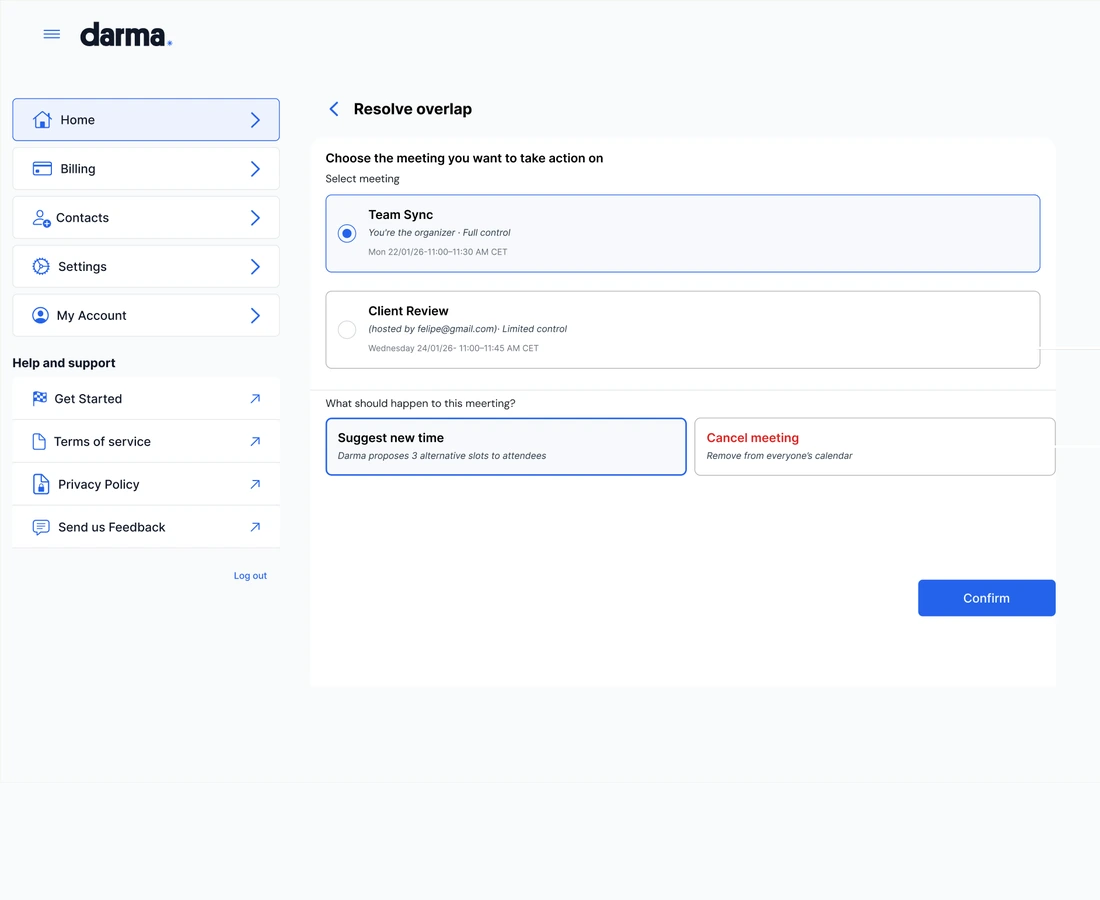
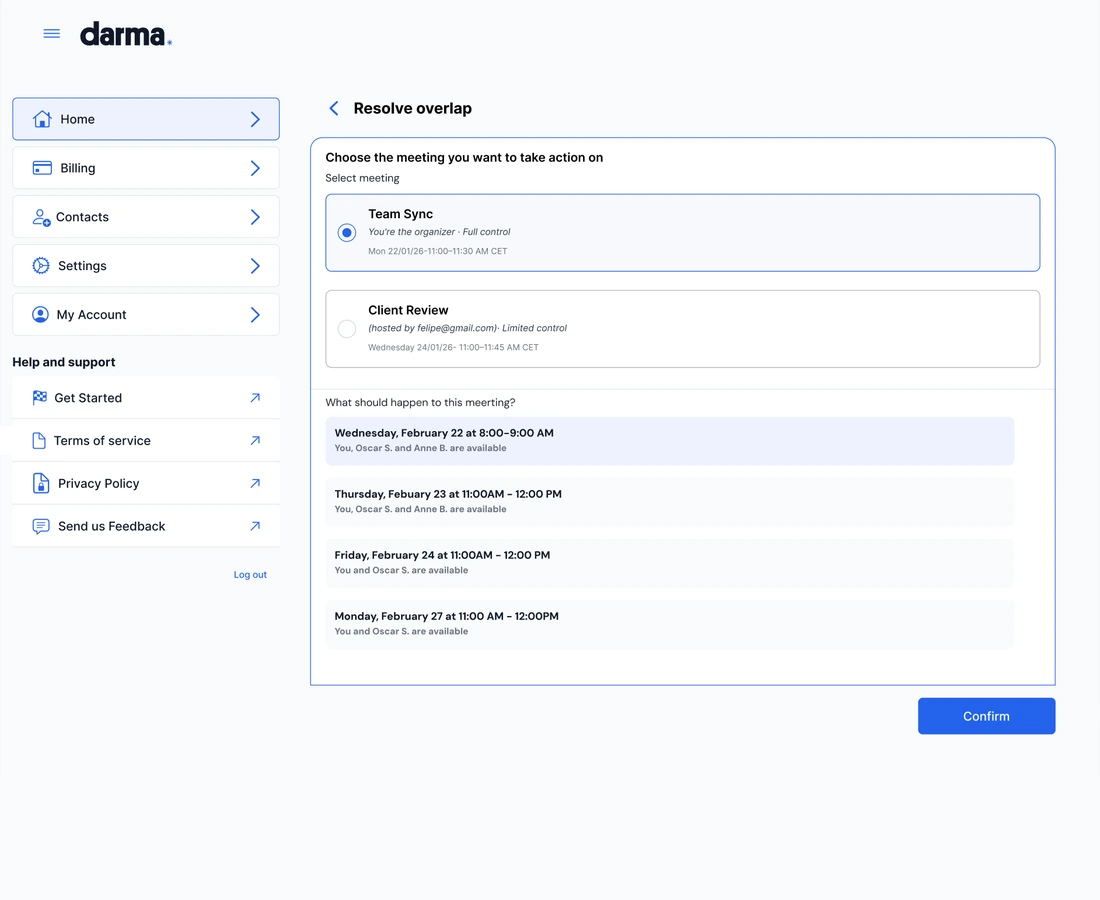
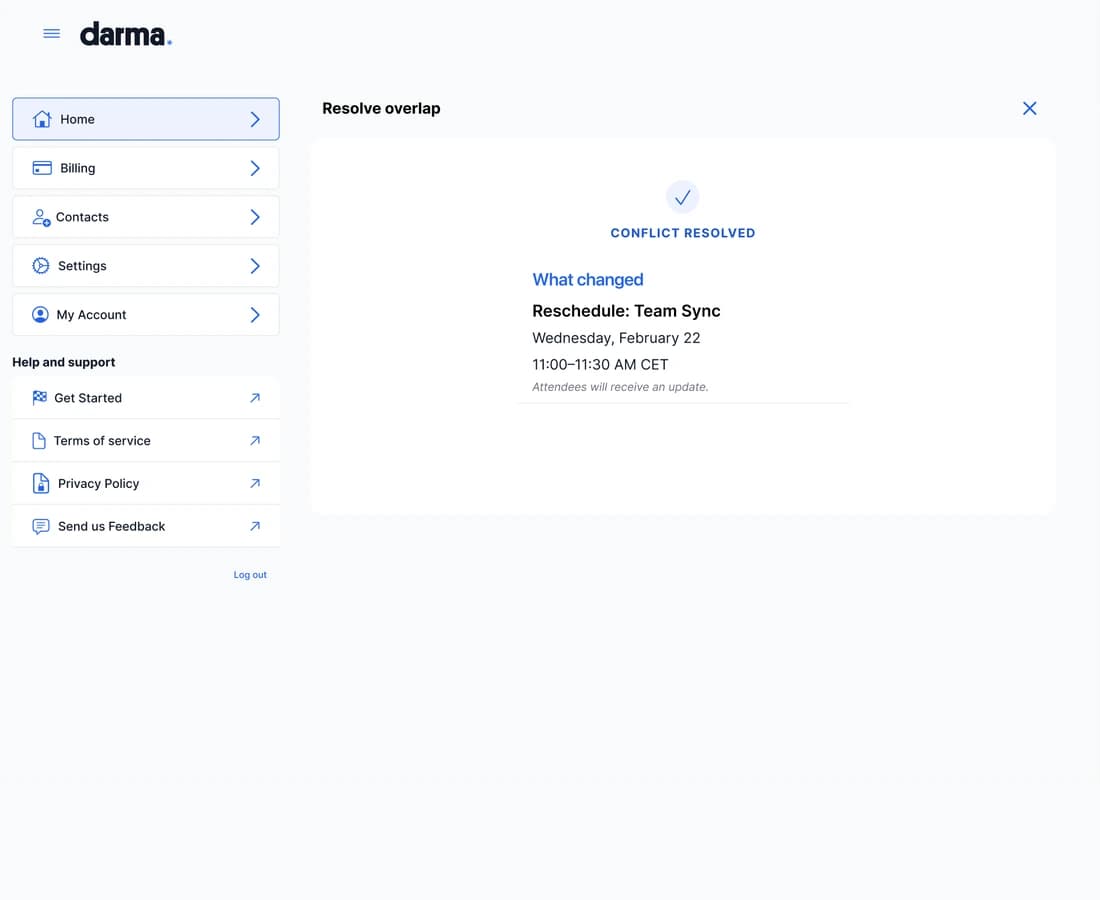
This is what that decision point looked like — on iOS and on web — a real conflict, and the choice Darma hands to the human instead of making it alone.
“Every continue was a decision Darma could make. Every stop was one it couldn't.”
The apps became command and control
iOS and web app — command and control. Conflicts flagged automatically, replies that need a decision, end-of-day recaps, and the settings that define Darma's rules — all without opening the email thread itself. Darma Chat lived only on iOS, for quick lookups — not for running the negotiation.
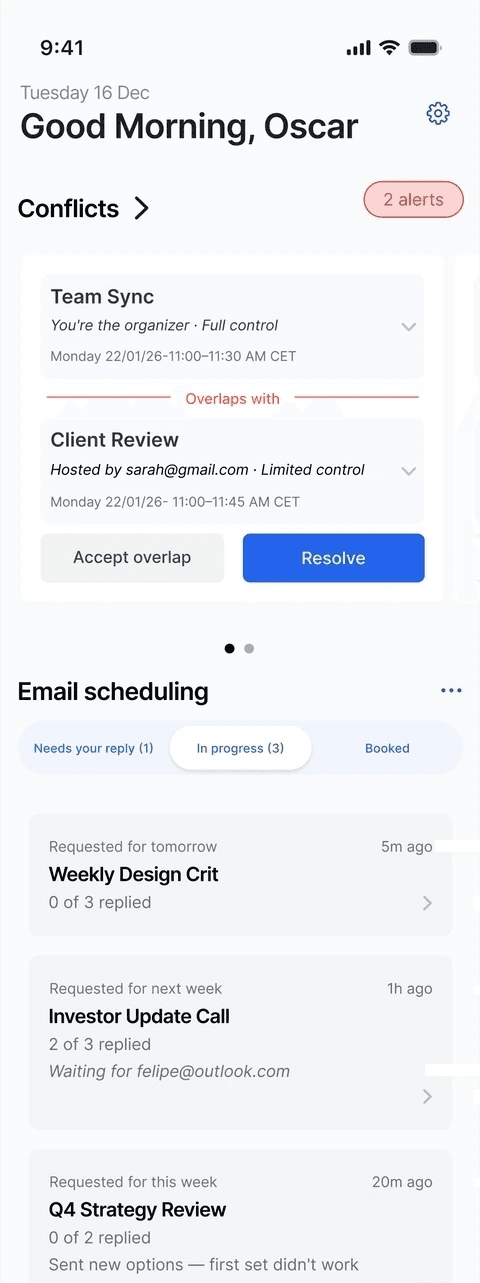
iOS — command & control
Web app — resolving an overlap
“Email did the work. The apps kept the human in control.”
The product grew. So did my role
I owned the creative direction of the entire product — the iOS app, the web app, and the marketing site. For a few months, I was also the engineering lead: I picked up terms I'd never needed before, learned Linear, translated priorities into tickets, and coordinated six engineers across five countries, alongside the design work itself.
“I wasn't just designing the product. I was building all of it.”
We didn't just launch it. We tested whether people would let Darma take over.
The go-to-market model gave every user 10 free meetings before needing to upgrade — and billing needed the same care as everything else: a clear meeting counter, an upgrade moment that didn't feel like a wall, and screens that explained exactly what came next.
50
active users
98%
meeting-booked rate
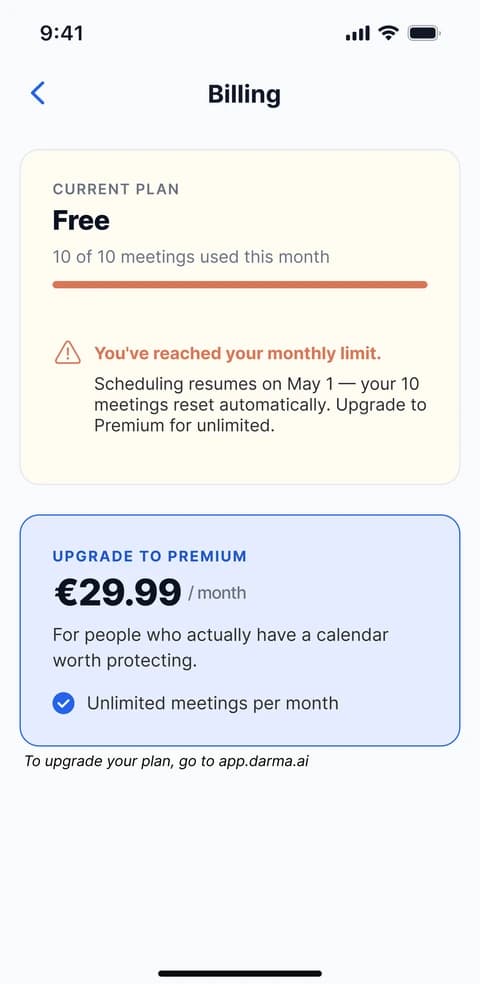
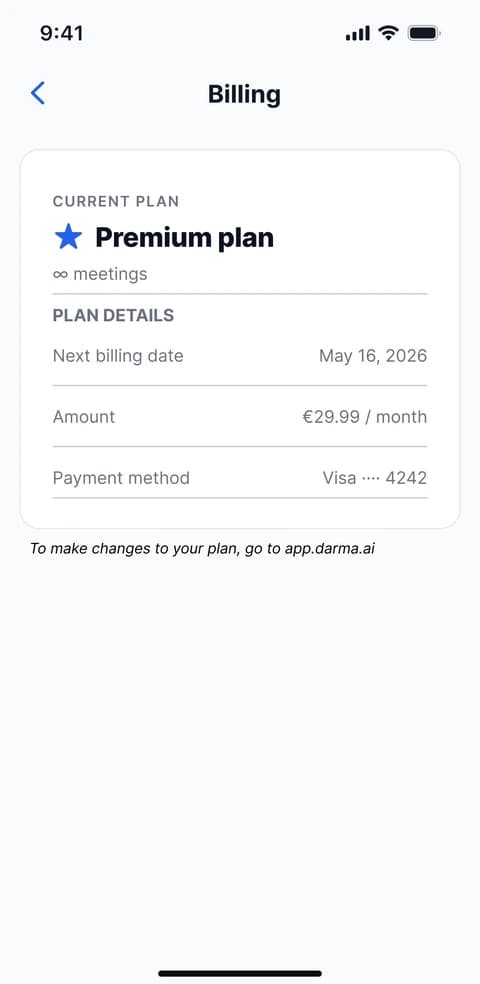
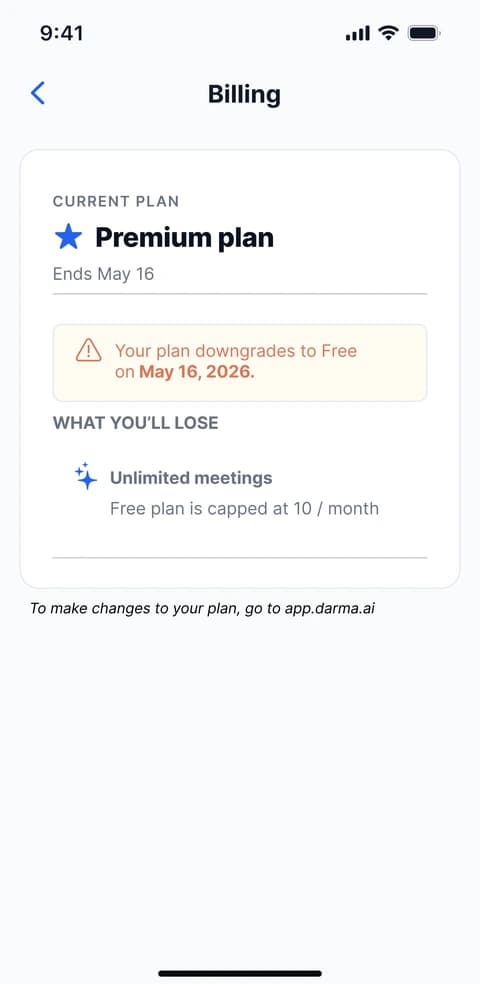
iOS — billing
A product you shouldn't have to use.
Darma wasn't designed to become another app competing for attention — the more useful it became, the less the user needed to interact with it. The email thread became the interface, the apps became command and control, and the human stayed in the loop without having to be in every loop.
When AI can read, decide and negotiate, good UX isn't about showing everything. It's about showing the right thing at the right moment.